
Grundy County Projected Release Dates
Tennessee's public state record uses precise labels. The TDOC FOIL search displays a “Release Eligibility Date” and a separate “Sentence End Date.” It does not label either field “Projected Release Date” or “Tentative Release Date.” Release eligibility is the point at which the governing sentence calculation permits release consideration or a statutory mechanism. It is not an appointment at the gate. The sentence end date concerns the calculation of the sentence itself.
An actual release is a later event. A Board grant may still require an approved plan and pre-release steps. A sentence date may change when TDOC receives more court papers. A detainer can route the person into another jail. For that reason, the displayed date should be copied with its exact label, then matched to the status, assigned location, active sentences, and any later release or discharge document.
A person held before trial is different. The Grundy County Detention Facility cannot supply a computed sentence end when no sentence exists. Bond, a judge's order, dismissal, time served, or transfer may change custody. The court file can show the legal order, while the sheriff's booking or release transaction shows when the jail processed it.
Find a Grundy Release Date
Begin with the custodian, not with a date calculator. A short county booking and a state felony sentence belong to different record systems. Grundy County has no verified public current roster or recent-release archive, so a county question goes to the sheriff and court. A state sentence goes first to FOIL. Federal confinement goes to the federal system, not the Tennessee date fields.
- Identify whether the person is pretrial, serving a county sentence, committed to TDOC, or held by another sovereign.
- For TDOC custody, search FOIL by name, TDOC ID, or State ID. Compare identity fields before opening a result.
- Copy Release Eligibility Date and Sentence End Date exactly. Save Supervision Status, Assigned Location, active sentences, offense data, and parole fields with them.
- For a Grundy County booking, call the Sheriff's Office at (931) 692-3466 and request the existing booking or release record. Ask the clerk for the judgment, bond order, or sentencing order.
- Check for consecutive sentences, detainers, later court action, Board action, and an actual release or discharge record before treating a date as final.
The official county contact is published on the Grundy County officials page. Sheriff Heath Gunter's office is at 227 Maple Street, Altamont, TN 37301. For the court side, use the Tennessee court clerk directory to identify the Grundy clerk and request the case document that controls the jail order.
The wider Grundy County released inmate search explains how a named person moves among jail, court, state, and federal records. It is useful when custody type is still unclear.
Note: A missing county roster entry does not establish release because transfer can remove a person from the local jail's current view.
FOIL Fields for Grundy Release Dates
FOIL covers felony offenders currently or formerly in TDOC custody or supervision. Its three search modes are Search By Name, Search By TDOC ID, and Search By State ID. The name form includes last name, first name, a race selector, and an option to include aliases that match. A case-sensitive CAPTCHA limits automated lookup, so the actual state application should be used.
On a detail record, identity and date fields work as a set. “Supervision Status” can say incarcerated, parole, probation, or inactive. “Assigned Location” might be a prison or a community-supervision office. The date field table below shows why no single row should be stripped from the record.
| FOIL field | How to read it |
|---|---|
| Release Eligibility Date | A calculated point for release consideration or another legal release mechanism, not proof of departure |
| Sentence End Date | The sentence calculation endpoint, subject to later court and agency inputs |
| Supervision Status | Whether TDOC reports incarceration, parole, probation, or inactive status |
| Assigned Location | The correctional assignment, which may be a prison or a field office |
| Parole Hearing Date and Result | Board-process facts that can precede release and do not by themselves prove it |
| Active Tennessee Sentences | Sentence entries that may affect the combined calculation or custody status |
The official FOIL field help documents the status and identifier terminology. Its captured interface shows the state definitions used to interpret a Grundy County release date lookup.
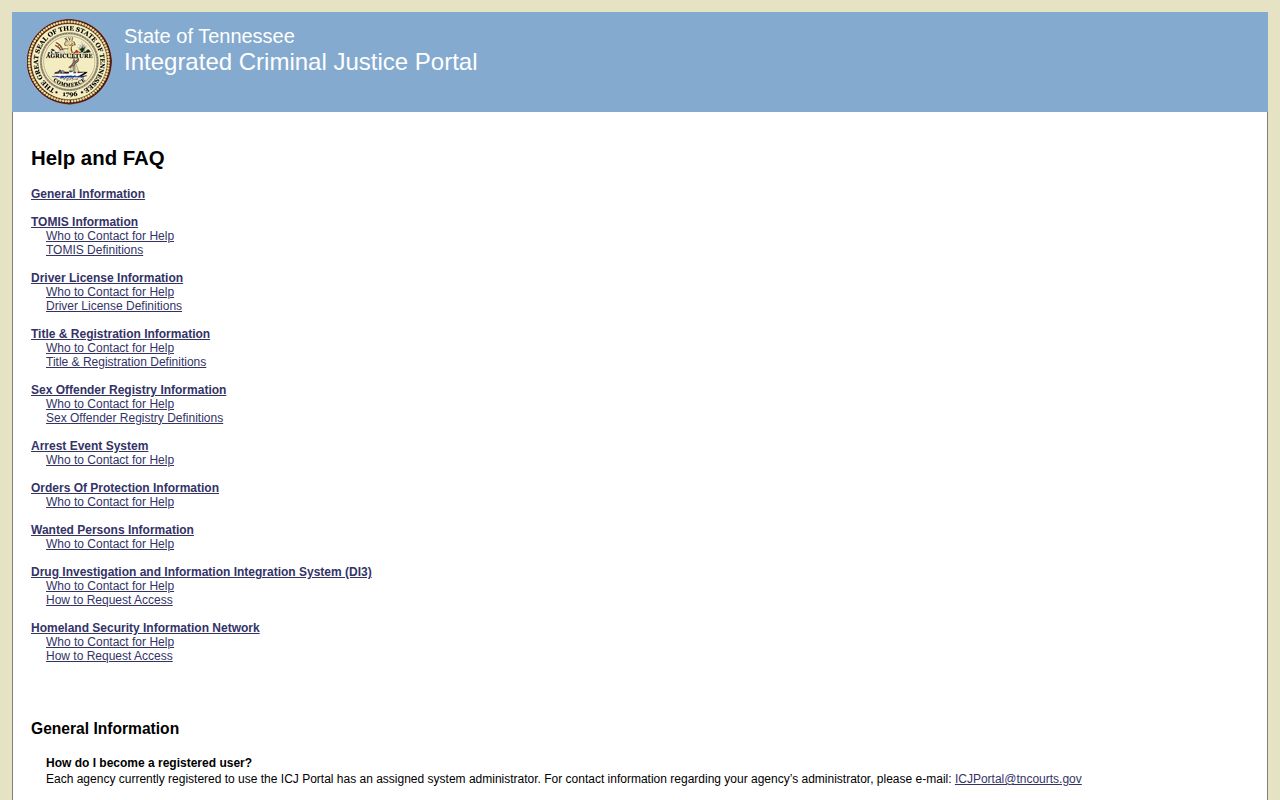
Use those state labels when taking notes or requesting clarification. Rewording an eligibility date as a guaranteed release date changes its meaning.
Tennessee Rules Behind Release Eligibility
Tennessee Code Annotated § 40-35-501 governs much of release eligibility. Under its general range provisions, an especially mitigated offender's eligibility is set at 20% or 30% as stated in the judgment. Range I is generally 30%, Range II 35%, Range III 45%, and career offender 60%, subject to offense-specific and credit rules. Felony sentences exceeding two years, including qualifying consecutive aggregates, are generally eligible for parole consideration. Sentences of two years or less use the determinate-release framework at the eligibility point, subject to statutory conditions and notice.
Tennessee is not a universal “85% state.” Section 40-35-501(u) applies an 85% rule to an enumerated set of offenses committed on or after January 1, 2017 and before July 1, 2022. Other subsections set rules for designated offenses, including provisions that can require all of the sentence or limit how credits affect parole eligibility. Life terms follow separate rules. The offense, offense date, range, judgment, and consecutive structure must be known before the governing rule can be identified.
A private statutory reproduction can help locate the current text of Tenn. Code Ann. § 40-35-501, but the citation and official legal record control. A public lookup should not turn those percentages into an individual promise. TDOC performs the sentence calculation from its full record.
Note: Eligibility rules depend on the exact offense and date, so a percentage alone cannot yield a reliable Grundy County release date.
Credits and Grundy Release Dates
Sentence reduction credits are principally governed by Tenn. Code Ann. § 41-21-236. The law permits awards from one to sixteen days for each month served, with no more than eight days for good institutional behavior and no more than eight for satisfactory program performance. These credits are documented and awarded monthly in the warden's discretion. They are not automatic. They can also be reviewed or removed.
The treatment changed for some newer sentences. For offenses before July 1, 2024, or a sentence under two years for an offense on or after that date, awarded credits may reduce the imposed sentence as the law directs. For a sentence longer than two years for an offense committed on or after July 1, 2024, credits reduce the time required before parole eligibility but do not change the sentence-expiration date. That distinction is one more reason to preserve FOIL's two date labels.
The same statute addresses state-sentenced felony offenders housed in local jails, possible presentence behavior credit supported by jail-administrator records, and misdemeanor credit. For a local misdemeanor sentence, the court fixes a service percentage from 30% through 100%, and credits cannot reduce that release percentage by more than 25%. These provisions affect agency calculations. They do not authorize a reader to forecast the Grundy County Detention Facility's release time.
Why Grundy Release Dates Change
A sentence calculation is a living agency record until the controlling events are complete. FOIL warns that dates may change as added court documents arrive. TDOC release policy also requires records staff to review sentence credits, Board action, detainers, unprocessed or missing sentences, and the accuracy of the calculation before an expiration release. A new input can change either eligibility or what happens on the apparent release day.
| Factor | Possible effect | Record to check |
|---|---|---|
| Awarded or removed credits | Changes time to eligibility under the rule governing the sentence | TDOC sentence and credit record |
| New court document | Corrects or adds a sentence, credit, range, or order | Court judgment and updated FOIL record |
| Consecutive sentence | Changes the combined sentence calculation | Active sentences and judgments |
| Detainer or hold | Can route the person to another custodian instead of the community | Release checklist, detainer, and receiving-agency record |
| Parole decision | A grant, denial, deferral, or rescission changes the path, though a grant is not release proof | FOIL hearing fields and final Board record |
| Release-plan processing | Can delay physical departure after a favorable parole action | Approved plan and release-day record |
An out-to-court flag or another hold can prevent a community release. Likewise, a “release by detainer” may mean transfer to a Tennessee county facility. The release date from one agency must be paired with the destination before it is described as freedom from all custody.
Confirm a Grundy Release Date
Actual state release has an administrative trail. TDOC Policy 511.03 requires a completed release checklist, records-office review, signatures from two records staff or their designees, a warden or superintendent approval, review of offender-management dates, and final authorization from Sentence Information Services. At sentence expiration, the policy describes a Letter of Discharge signed by the warden or superintendent. A release-day transaction, executed certificate, or discharge letter can resolve what the public FOIL date cannot.
After an eligibility date passes, look for a changed Supervision Status and Assigned Location. Parole or probation indicates community supervision, not full discharge. Inactive may support that active TDOC custody or supervision ended, but it still needs the sentence and date context. For an unclear record, use the TDOC archived-record request route and ask narrowly for an existing discharge letter, certificate, or responsive movement and release record.
A pending event can also be monitored through the Grundy County VINE inmate check, but an alert only reports what the participating agency transmitted. For a county detainee, confirm with the sheriff's release transaction and court order. For a state prisoner, confirm with FOIL and TDOC. For a federal prisoner, use the BOP locator.
Note: Save the source, exact field label, and lookup date whenever a release date is used in a personal or court-related inquiry.